Showing posts with label world coins. Show all posts

Friday, October 5, 2012

Circulation Commemoratives

These are some of the most unique and interesting coins produced in the modern era. They consist of an ongoing or serial subject, which are released for general circulation. A good example is the 1999-2008 Statehood quarter-dollar program of the United States. Canada had a similar program series commemorating the new Millennium, which released one new design into circulation per month in 1999 and 2000.

Unlike precious medal commemoratives, these are base metals and are produced by the millions. In some instances, a portion of the circulation commemorative run is produced in specialized collector folders. There are cases when a standard issue of the denomination is released along side the commemorative, as in the 1993-1999 Spanish 5 Peseta production run. Circulation commemoratives can be released annually- one design in a single year, or perennially- more than one design in a single year.

There are other criteria under which circulation commemoratives are issued. A particular denomination is usually chosen for a particular series of commemorative issues, such as the British 50 pence series released in 2012 to celebrate the London 2012 Olympics. In the case of Spain, however, the lowest four denominations, 5, 10, 25 and 50 Peseta coins were issued with circulation commemorative runs. In other cases such as Germany, only the 2 Mark denomination was released with a commemorative design.

All of these production runs are usually issued in very large quantities- generally 1 million or more per design is considered a quantity suitable for circulation. Instances where a fair amount of deviation exists between issues in a single series can lead to a higher demand for the lower produced designs. This can lead to hoarding one design over another when it is encountered in general circulation. It is the same principle as Gresham’s law, only mintage figures determines demand instead of debased medal content. An example of this is the 2003-2004 Statehood series production of US quarter dollars. The ten designs released during this period have the lowest mintage figures of the entire 10-year lifespan of the entire program. As a result, they command higher prices in the secondary market, even though several hundred million specimens exist (from both mint facilities).

Collector and general public interest in a commemorative program can sometimes dictate the future of the program, even before it is finished. The United States began the Presidential $1 program in 2007, which saw the release of four designs per year, each with a different US President as the subject. Because the US produced hundreds of millions of these coins, interest diminished beyond the initial year. In 2011, the US Mint decided to drastically reduce the number of Presidential Dollar coins it would produce for the remainder of the program. It is still unclear how this mintage reduction will impact the success of the program moving forward.

While it is nearly impossible to find a large monetary authority that does not produce circulation commemoratives today, this practice was almost unheard of only twenty years ago. One of the first circulation commemorative to be produced by a modern major monetary authority was in 1967, on the occasion of Canada’s 100th Anniversary of Confederation. All of the coin denominations in circulation at the time were released in normal quantities with a different design.

Some national banks and monetary authorities, it has been suggested, began issuing these circulation commemoratives in order to create value in the minted coinage, which does not otherwise exist since most currencies debased their coinage decades ago. Obviously the value of these circulation commemoratives do not come near the value of their precious medal counterparts, so this solution is questionable.

Whatever the reason these issues were started, collectors and enthusiasts love them! To that end, I’ve created several web pages (Italy, Russia and Spain so far) in an effort to catalog as many of these issues as I can: http://www.richwertzonline.com/coins/Circ_Comm_IT_200L.html

Wednesday, November 30, 2011

Canadian 60th Anniversary of VE-Day

As I mentioned before, this beautiful and nicely arranged commemorative issue contains a sterling silver reproduction of the 1945 5-cent coin, complete with King George VI on the front. The set also features a bronze medallion. Both are inside of a tin, with great inserts.

The problem is that it came shrink wrapped and I desperately want to open it and see these treasures with my own eyes. The only reason I know that the inserts are nicely done is because I saw the picture of them from the person I bought the set from on eBay.

I’m not sure what merits may lie in keeping the shrink wrap intact. To be sure, original packaging is oh so important for collectibles such as action figures and PEZ dispensers. But what about a commemorative coin issue? Can there be any harm or loss in value from merely opening the container?

As long as the coin and medallion remain in whatever protective casing they’re in, the value shouldn’t be diminished at all. Naturally, there is a cardboard sleeve around the tin, which adds a very catching element to the packaging overall.

Besides all that, there are already tears in the shrink wrap. None so much that it looks anything less than pristine, but isn’t any value added by virtue of shrink wrap diminished with the tearing of said shrink wrap?

If the set is kept nicely and the sleeve is intact, does the value change without the shrink wrap?

I’m guessing no and will open it regardless so that my curiosity will finally be satiated.

Wednesday, August 3, 2011

Coin shortage in Kenya

This was an interesting story I happened across while looking for videos on You Tube for my school’s final project. It seems that close to 2 billion Kenyan Shillings worth of coins are being kept by citizens in Kenya. Late in June of this year, the Central Bank of Kenya began a campaign to bring the coins back into circulation. They called it ‘coin week’ and it is hoped to halve the amount of coins being kept by the population.

Most of the interviewees for the story said that shops no longer accept the 50 cent coin, because of its low value. In fact, instead of giving out a 50 cent coin in change, some shops are substituting the coin for a piece of candy. Some banks do not accept coins in deposits and others charge fees for taking coins.

From the time of independence in 1963, Kenya has been using the Shilling as its currency, which is made up of 100 cents. Since about 1991, Kenyan sub-unit denominated coins have been made of plated steel. Since 1995, the 50 cent coin was the highest Shilling sub-unit coin in production. The highest denomination presently produced is the 40 Shilling coin, which makes the 50 cent coin 1/80 of the highest circulation coin- not quite as small as the US Lincoln cent, but still pretty small.

It takes about 91 Kenyan Shillings to equal $1 US.  Therefore, the Kenyan 50 cent coin is worth about a half cent. However, according to many of the comments on the You Tube video, there are still plenty of things one can buy with 50 cents- probably just a piece of candy.

Wednesday, March 23, 2011

Coins as Jewelry

Cha-Ching is a Pittsburgh-based business whose proprietor specializes in converting typical coins into various forms of jewelry. We found her table at the city’s central street market. The majority of pieces were earrings, bracelets and necklaces- the central focal point of each is a coin with most accompanied by beads or metal rings, etc.

While I take certain issue with the method of piercing coins with a hole in order to string a chain or rope through it, the practice is an excellent way to appreciate coins from a non-collector point of view. As long as the coin will always be used as jewelry, the value of the coin is actually quite high compared with the numismatic value of it.

When she found out that I have tons of extra coins that she might be interested in, she wrote her email address on her card and asked me to get in touch with her and suggested that if there was something that we were interested in, perhaps the value of the coins that she might want out of my collection could be put toward a purchase. Of course my better half was very excited- as there were no Dutch coins there, and I have several hundred that could easily be made into a bracelet.

Last night, I enlisted the better half to suggest which coins might make good candidates for jewelry. Most of the ones she picked had flowers or birds on them. I’m including the new US ‘shield’ pennies, of which I have several hundred. The older Singapore coins, with sea-animals are some of my favorite and I have a hard time parting with them, but at least I have several more in my collection.

The owner of Cha-Ching, Suzy, is meeting us tonight to evaluate our picks. Hopefully, out of the three pounds of coins, there is enough to equal the price of a nice bracelet made of Dutch coins, plus some left over.

Her business website is something that can’t be missed: http://www.chachingcoinjewelry.com

Monday, February 28, 2011

Vintage Hauls

Another treasure hunter’s dream courtesy of eBay. The first came in the form of a golfing themed humidor stuffed with coins and tokens. These were first rate vintage coins, too- well, first rate for me! About a dozen or so half-penny coins from all over the British Empire were in just my first handful. In all, about 6 silver pieces and a super special 1973 date set from Greece. Along with about a dozen or so Chinese cash and bronze ‘dollar’ coins, a few German-Occupied Netherlands coins were mixed in with the bunch, too. A few Weimar Republic new year tokens turned up, and quite a handful of Nurnberg Classic Car show coins dated from 1960.

The second haul was a simple 1lb bag of mixed world coins. This was a big surprise. I found four Soviet 1 ruble commemorative coins in the mix. A Mexican date set was also in there from 1994- including the 2 and 5 new peso coins. A few older British coins and quite a few German-Occupied French coins were in the mix as well.

After about a week or so, I finally managed to find the time to start sorting through all of them, but it led to two whole weeks of coin therapy.

Wednesday, January 5, 2011

The end of bronze coinage

Over the last 20-25 years, bronze coins in countries all over the world have gradually suffered the same fate as silver coinage did 50 years ago. While the end of silver coinage was relatively quick in some parts of the world, the replacement of copper coinage is happening at a much slower pace. Nonetheless, it is happening.

One of the first major world economies to replace copper in small denominated coins was the US and it was the one cent coin which lost its copper content- at least the majority of it in 1982. With copper prices a bit higher than historically normal prices at about $4.35 per pound, and taking into account the weight of the US one cent coin, only 136, or $1.36, contain enough copper to equal a pound and thus $4.35. The higher copper price is resulting in a manifestation of Gresham’s Law, which in part states that ‘good money is driven out by bad money’. In other words, people will keep the good money and circulate the bad money. This happened in the mid-sixties in the US, when the 90% silver dimes and quarters were replaced with a cupro-nickel composite.

In 1992, the UK and Ireland replaced their 1p and 2p coins, which were composed of 97% copper, with copper clad steel. The copper content dropped to just under 8%. In 1997, Canada replaced the majority of copper in their pennies with zinc and then steel in 2000. Russia replaced the copper content in their kopeck denominations with steel in 2006. Copper disappeared altogether from Mexican centavo coins in 1986. From then until the New Peso was introduced in 1993, there was no copper in any Mexican coins. Presently, the only copper can be found in the bi-metallic 1, 2, and 5 peso coins- and only in the center. The rings are steel. Most Central and South American countries have coinage that is composed of steel.

Along with the removal of copper and bronze coinage, there is a shift toward steel or clad zinc and nickel from cupro-nickel coins. The amount of copper in some of the higher-denominated coins around the world, especially the Euro coins and US coins, however, is secure since a startling jump in copper prices would need to occur before scrutiny is brought to their composition. It would take almost 100 US quarters, for example, to equal a pound of copper. This would be an intrinsic value of $4.35 vs. a face value of $25.00.

Copper composed circulation coinage has a long history in many parts of the world and holds a small part in the history of a number of countries and even cultures. The removal of copper from the worlds coins only serves to reduce the over all value of the coinage. There is no value in steel. Old silver coins were backed by their very intrinsic value. The same can be said of copper or copper alloy coins as well. The value of a 1979 one cent piece from the US is higher than a present day one cent piece. The copper content may in fact be worth more than $0.01, but at least there is value to the coin.

Present day coinage holds little value. Because of the increased population of the planet, more government are being forced to produce more coins. Higher mintage figures coupled with the reduction of precious metals in the coins of today is reducing the value of the coins to collectors. Worse still, it is greatly reducing the overall value of the currency itself.

Monday, January 3, 2011

Changing face of Brazilian currency

When sorting coins from Brazil, I became acutely aware that there are several coin designs that span a number of currencies. For example, in the 10 years between 1985 and 1995, the Brazilian currency went from the New Cruzeiro, both Cruzados, a third Cruzeiro, Cruzeiro Real and finally ended up with the present currency of Real. Ironically, the Real was the first currency used in Brazil until 1947, when the first Cruzeiro was introduced.

In an effort to accurately correlate my coins with the appropriate currency, I set out on a quest to obtain this information. What is here is what I have found.

First Currency: Real 1620-1947

As a Portuguese colony from 1620-1822, much of the Brazilian economy revolved around its sugar industry and a brief gold rush. The currency used was the Real (Réis) with no subdivision. Copper coins were produced with denominations of 5, 10, 20 and 40 Réis, silver was used for the 75, 150, 300 and 600 Réis coins and gold for 1000, 2000, 4000 and 6400 Réis. The 1778 silver coinage reformation produced denominations of 80, 160, 320 and 640 Réis, with gold 800, 1600 and 3200 Réis coins produced between 1780 and 1782. In 1809, existing copper and silver coins were over punched with the Portuguese arms, and the denomination doubled for 5, 10, 20 and 40 Réis coins. The values of the 75, 150, 300 and 600 Réis coins were increased in value to 80, 160, 320 and 640 Réis, respectively. To completely resolve the older Spanish coinage in circulation, these were over punched to produce 960 Réis coins in 1810. An 80 Réis coin was introduced in 1811.

Another coinage reformation took place between 1833 and 1835 which resulted in a copper coinage standard for the entire country and an over punch for all existing copper coins produced 10, 20 and 40 Réis coins. Silver 100, 200, 400, 800 and 1200 Réis coins and a 10000 gold Réis coin were introduced in this reformation as well. By the late 1840s and extending into the mid 1850s, the currency was reformed further by reducing the silver and gold content in the coinage. A new series of silver and gold coins were produced in denominations of 200, 500, 1000 and 200 silver Réis, and 5000, 10000, 20000 gold Réis. Between 1868 and 1873, bronze 10, 20 and 40 Réis coins were produced. Copper-nickel 50, 100 and 200 Réis coins were introduced in 1871.

400 and 20 Réis copper-nickel coins were introduced in 1901 and 1918 respectively. 1922 saw aluminum-bronze 500 and 100 Réis coins. In 1936, copper-nickel 200 Réis, aluminum-bronze 2000 Réis and silver 5000 Réis coins were introduced.

Second Currency: Cruzeiro 1947-1967

In 1947, Brazil began using the Cruzeiro (Cr / ₢), named for the Southern Cross constellation, as its currency, which replaced the Réis at a rate of 1000 Réis to 1 Cruzeiro. The new Cruzeiro was divided into 100 centavos.

Coins of the first Cruzeiro 1947-1956
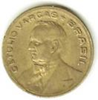
First Cruzeiro- centavo coin common obverse 1947 - 1956
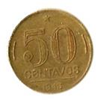
First Cruzeiro- 10 centavos coin 1947 - 1956 First Cruzeiro- 20 centavos coin 1947 - 1956 First Cruzeiro- 50 centavos coin 1947 - 1956


First Cruzeiro- Cruzeiro coin common obverse 1947 - 1956
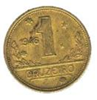
First Cruzeiro- 1 cruzeiro coin 1947 - 1956 First Cruzeiro- 2 cruzeiros coin 1947 - 1956 First Cruzeiro- 5 cruzeiros coin 1947 - 1956

Initially, the coins were composed of copper-nickel for the sub-division denominations and aluminum-bronze for the currency denominations. Starting in 1956, the design of all coins changed, as did the composition- they were now made of aluminum. The 2 and 5 Cruzeiro were discontinued.

First Cruzeiro- Cruzeiro / centavo coin common obverse 1956 - 1961
First Cruzeiro- 10 centavos coin 1956 - 1961 First Cruzeiro- 20 centavos coin 1956 - 1961 First Cruzeiro- 50 centavos coin 1956 - 1961 First Cruzeiro- 1 Cruzeiro coin 1956 - 1961 First Cruzeiro- 2 Cruzeiros coin 1956 - 1961

By 1961, the currency was devalued to the point where coin production stopped completely. When it resumed in 1965, the only coins produced were Cruzeiros made of aluminum for the 10 and 20 and copper-nickel for the 50. Centavo coins were withdrawn from circulation. By the end of 1968, all coins were withdrawn from circulation.

First Cruzeiro- common obverse design for Cruzeiro coin 1965
First Cruzeiro- 10 Cruzeiros coin 1965 First Cruzeiro- 20 Cruzeiros coin 1965

Third Currency: Cruzeiro Novo 1967-1986

By 1967, the Cruzeiro was beyond salvage from rampant inflation, a state which a multitude of Brazilian currencies would exist for another thirty years. The first solution was to introduce a new currency, called Cruzeiro Novo (also divided into 100 centavos), which was valued at 1000 Cruzeiros.

The first coins produced for the new currency were denominated in 1, 2, 5, 10, 20 and 50 centavos and 1 Cruzeiro.

Second Cruzeiro (Novo)- common obverse design for centavo / Cruzeiro coin 1965 - 1986
Second Cruzeiro (Novo)- 1 centavo coin 1965, 1969, 1974 Second Cruzeiro (Novo)- 2 centavos coin 1965, 1969, 1974 Second Cruzeiro (Novo)- 5 centavos coin 1965, 1969, 1974
Second Cruzeiro (Novo)- 10 centavos coin 1967, 1970, 1974 - 1979 Second Cruzeiro (Novo)- 20 centavos coin 1967, 1970, 1975 - 1979 Second Cruzeiro (Novo)- 50 centavos coin 1967, 1970, 1975 - 1979
Second Cruzeiro (Novo)- 1 Cruzeiro coin 1970, 1974 - 1979

The three lowest denominations were stainless steel, while the others were composed of copper-nickel. The copper-nickel coins were eventually replaced by stainless steel and a modified design.

By 1979, inflation gripped the new Cruzeiro and the centavo coins were removed from circulation since they were worthless. Over the following three years, a new design appeared on a smaller 1 Cruzeiro coin and the 5, 10, 20 and 50 Cruzeiro coins were introduced. In 1985, smaller 100, 200 and 500 Cruzeiro coins were being produced. These were all composed of stainless steel.

Second Cruzeiro (Novo)- 1 Cruzeiro coin 1979 - 1985
Second Cruzeiro (Novo)- 5 Cruzeiros coin 1980 - 1984
Second Cruzeiro (Novo)- 10 Cruzeiros coin 1980 - 1986
Second Cruzeiro (Novo)- 20 Cruzeiros coin 1981 - 1986


Second Cruzeiro (Novo)- 50 Cruzeiros coin 1981 - 1986
Second Cruzeiro (Novo)- 100 Cruzeiros coin 1985, 1986
Second Cruzeiro (Novo)- 200 Cruzeiros coin 1985, 1986
Second Cruzeiro (Novo)- 500 Cruzeiros coin 1985, 1986

Fourth Currency: Cruzado 1986-1989

The Novo Cruzeiro had a long death, but was replaced in the end with the Cruzado (Cz$), divided into 100 centavos, at a rate of 1000 Novo Cruzeiro = 1 Cruzado.

The first Cruzado coins issued were composed of stainless steel in denominations of 5, 10, 20 and 50 centavos and 1, 5 and 10 Cruzado coins. Just two years after these coins were minted, production ceased. Again, the currency fell victim to rampant inflation.

First Cruzado- common obverse design for centavo / Cruzado coin 1986 - 1988
First Cruzado- 1 centavo coin 1986 - 1988 First Cruzado- 5 centavos coin 1986 - 1988 First Cruzado- 10 centavos coin 1986 - 1988 First Cruzado- 20 centavos coin 1986 - 1988
First Cruzado- 50 centavos coin 1986 - 1988 First Cruzado- 1 Cruzado coin 1986 - 1988 First Cruzado- 5 Cruzados coin 1986 - 1988 First Cruzado- 10 Cruzados coin 1987 - 1988

Fifth Currency: Cruzado Novo 1989-1990

In January, 1989, the Cruzado Novo (NCz$) was established at a rate of 1000 Cruzados = 1 Cruzado Novo. The currency was divided into 100 centavos. Coin denominations were issued in denominations of 1, 5, 10 and 50 centavos and 1 Cruzado Novo, composed of stainless steel.

Second Cruzado (Novo)- 1 centavo coin 1989 - 1990
Second Cruzado (Novo)- 5 centavos coin 1989 - 1990
Second Cruzado (Novo)- 10 centavos coin 1989 - 1990
Second Cruzado (Novo)- 50 centavos coin 1989 - 1990
Second Cruzado (Novo)- 1 Cruzado Novo coin 1989 - 1990

Sixth Currency: Cruzeiro 1990-1993

Unlike the previous four currencies, whose introduction was the result of rampant inflation, this Cruzeiro, also known as the Third Cruzeiro, was merely the result of renaming the Cruzado Novo. It was introduced less than 14 months after the introduction of the Cruzado Novo, and replaced it at a 1:1 ratio.

Since this Cruzeiro was also divided into 100 centavos and replaced the Cruzado Novo at par, the centavo coins issued for the previous currency were kept in circulation and only the 1 Cruzado Novo coin was withdrawn from circulation. Stainless steel 1, 5, 10 and 50 Cruzeiro coins were issued in 1990.

Third Cruzeiro- 1 Cruzeiro coin 1990
Third Cruzeiro- 5 Cruzeiros coin 1990, 1991
Third Cruzeiro- 10 Cruzeiros coin 1990, 1991, 1992
Third Cruzeiro- 50 Cruzeiros coin 1990, 1991, 1992

Despite the effort to stem the ebb and flow of rampant inflation followed by the introduction of a new currency, less than two years after renaming the Cruzado Novo to the Cruzeiro, inflation again took hold of the currency and higher denominations of coins were issued. Smaller stainless steel 100, 500, 1000 and 5000 Cruzeiro coins were introduced. The coins issued previously became worthless and were taken out of circulation.

Third Cruzeiro- 100 Cruzeiros coin 1992, 1993
Third Cruzeiro- 500 Cruzeiros coin 1992, 1993
Third Cruzeiro- 1000 Cruzeiros coin 1992, 1993
Third Cruzeiro- 5000 Cruzeiros coin 1992

Seventh Currency: Cruzeiro Real 1993-1994

The Cruzeiro Real (CR$) was introduced at a rate of 1000 Cruzeiros = 1 Cruzeiro Real and was subdivided into 100 centavos, but the sib-divided unit was never practically represented as either coins or banknotes. The only coins issued were composed of stainless steel and denominated into 5, 10, 50 and 100 Cruzeiro Reais.

Cruzeiro Real- 5 Cruzeiro Reais coin 1993, 1994
Cruzeiro Real- 10 Cruzeiro Reais coin 1993, 1994
Cruzeiro Real- 50 Cruzeiro Reais coin 1993, 1994
Cruzeiro Real- 100 Cruzeiro Reais coin 1993, 1994

This currency was different in many ways to the previous currencies issued since the first Cruzeiro in 1946. Its purpose was to allow the population to become accustomed to a stable currency. It was pegged to the US Dollar and there was a price parity program established. After 11 months, the Cruzeiro Real was replaced.

Eighth Currency: Real 1994-Present

The Real (R$) is a result of a substantial monetary, economic and currency reform put forth to end inflation that plagued the economy since 1956. It was introduced at a rate of 2750 Cruzeiro Reais = 1 Real and was divided into 100 centavos.

Coins issued were composed of stainless steel at first in denominations of 1, 5, 10 and 50 centavos and 1 Real. The obverse was common and the reverse was considered a generic design whose elements were similar between denominations. A 25 centavo coin was produced in 1995 as a vehicle for commemorative designs, but also had a standard design different from the other denominations in the series.

Real- centavo / Real common obverse coin design
Real- 1 centavo coin 1994 - 1997 Real- 5 centavos coin 1994 - 1997 Real- 10 centavos coin 1994 - 1997 Real- 50 centavos coin 1994, 1995 Real- 1 Real coin 1994

After four years, the stainless steel designs were replaced with cons containing higher value metal alloys in recognition of the intrinsic value of the currency the coins represented. The coins in the first series remain legal tender, but are being withdrawn from circulation.

Real- 1 centavo coin 1998 - 2004
Real- 5 centavos coin 1998 - present
Real- 10 centavos coin 1998 - present


Real- 25 centavos coin 1998 - present
Real- 50 centavos coin 1998 - present
Real- 1 Real coin 1998 - present

The 1 and 5 centavo coins are composed of copper plated steel, the 10 and 25 centavo coins are composed of brass plated steel. The 50 centavo coin was made of copper-nickel until 2002 when the composition changed to stainless steel. The 1 Real coin was bi-metallic and composed of copper nickel with a brass ring until 2002, when the center was changed to stainless steel. In 2005, the 1 centavo coin was no longer being produced, but is still legal tender.

Despite its relatively young age, the Real seems to be a solid currency and has outlasted its predecessors in terms of stability.